
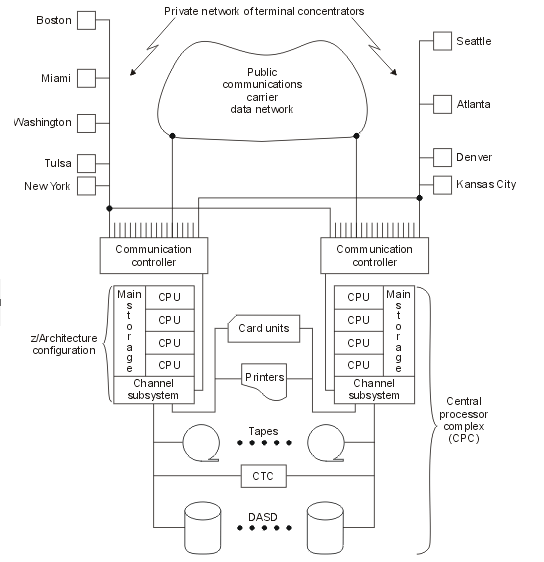
“The z/TPF system is a high availability operating system designed to provide quick response times to high volumes of messages from large networks of terminals and workstations. A typical z/TPF system handles several hundred messages per second. A typical network varies from several hundred terminals and workstations to tens of thousands. The response time of the z/TPF system within a network is typically less than three seconds from the time the user sends a message to the time the user receives a response to that message. High availability is enhanced by the ability to quickly restart the system; restarting after a system failure takes between 30 seconds and two minutes. The z/TPF system is a high availability operating system designed to provide quick response times to high volumes of messages from large networks of terminals and workstations. A typical z/TPF system handles several hundred messages per second. A typical network varies from several hundred terminals and workstations to tens of thousands. The response time of the z/TPF system within a network is typically less than three seconds from the time the user sends a message to the time the user receives a response to that message. High availability is enhanced by the ability to quickly restart the system; restarting after a system failure takes between 30 seconds and two minutes” (IBM, n.d.).
Here is a diagram representing a z/TPF Processing Center (IBM, n.d.):
For many people the term z/TPF may seem unusual, but this mainframe operating system, originally called Transaction Processing Facility or simply TPF, has been active since the 70’s, and it had its origins during the 60’s. The z in z/TPF stands for z/Architecture, meaning 64-bit memory addressing capacity. It is 2**64 bytes of memory or (18,446,744,073,709,551,616 bytes).
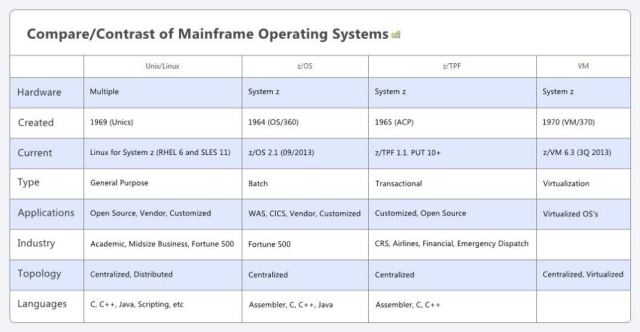
The following table compares and contrasts some of the Mainframe Operating Systems:
Legacy systems present many unique challenges and advantages, because of their inherent characteristics. They are monolithic, session based, the code usually has been designed to meet aged technologies and has become obsolete; their millions of lines of code are difficult to modify and/or maintain, but they are resilient, fast and still deliver acceptable to good services.
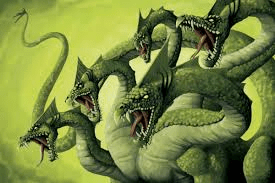
Many companies must decide how to deal with their legacy systems to improve their productivity, revenue and competitive advantage. They need to know how to deal with the “Beast”.
Migrate functionality to other platforms, refactor legacy code, cultural change for adopting agile technologies, isolate the mainframe to embrace new technologies; are some of the options to face and decide. Enterprise Architecture is the required big player to help.
References
IBM. (n.d.). Introduction to the z/TPF system. Retrieved from IBM Knowledge Center: http://www.ibm.com/support/knowledgecenter/SSB23S_1.1.0.13/gtpc3/ch1.html
Ross, J. W., Weill, P., & Robertson, D. S. (2006). Enterprise Architecture as Strategy. Boston: Harvard Business Review Press.
The Open Group. (2014). TOGAF Version 9.1. Van Haren Publishing.


 Jorge Luis Rodriguez Blog