
Cloud computing combines the best of the mainframe era with the best of the PC-enabled client-server era along with the Internet era (Kavis, 2014). If managed correctly, cloud computing can provide central control governance plus a massive amount of distributed computing resources, broad network access over the Internet and those services may be paid as if they were a utility, like water or electricity.
The National Institute of Standards and Technology (NIST) (Mell & Grance, 2011) defines Cloud Computing as “a model for enabling ubiquitous, convenient, on-demand network access to a shared pool of configurable computing resources (e.g., networks, servers, storage, applications, and services) that can be rapidly provisioned and released with minimal management effort or service provider interaction”.
NIST cloud model defines five essential characteristics, three service models and four deployment models. The next diagram illustrates the NIST cloud computing framework.
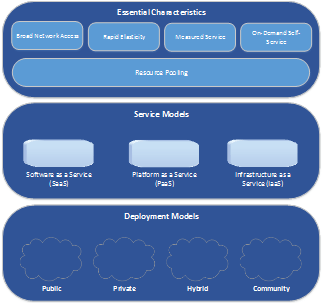
To determine whether an IT service is a cloud solution, it must meet all five essential NIST characteristics. After the service satisfactorily meets all five characteristics, the service and deployment model may be determined. Service and deployment models do not factor into the determination of whether an IT service is cloud computing (Gartner, 2014).
Cloud computing is probably the biggest technological shift since the personal computer and the wide adoption of the Internet, but Cloud computing is still in its infancy; it is needing standards and best practices.
“It is important to distinguish the term “cloud” and the cloud symbol from the Internet. As a specific environment used to remotely provision IT resources, a cloud has a finite boundary. There are many individual clouds that are accessible via the Internet. Whereas the Internet provides open access to many Web-based IT resources, a cloud is typically privately owned and offers access to IT resources that is metered” (Erl, Puttini, & Mahmood, 2013).
“Cloud computing adoption is not trivial. The cloud computing marketplace is unregulated. And, not all products and technologies branded with “cloud” are, in fact, sufficiently mature to realize or even supportive of realizing actual cloud computing benefits. To add to the confusion, there are different definitions and interpretations of cloud-based models and frameworks floating around IT literature and the IT media space, which leads to different IT professionals acquiring different types of cloud computing expertise” (Erl, Puttini, & Mahmood, 2013).
Gartner research (Gartner, 2015) found these conclusions about Cloud technology for 2016:
- Hybrid will be the most common usage of the cloud — but this requires the public cloud to be part of the overall strategy.
- The defensive stance that dominated the large software vendor strategies toward the cloud has been replaced in recent years with a cloud-first approach. Today, most vendor technology innovation is cloud-centric, with the stated intent of retrofitting the technology to on-premises.
- Failure to put the people and processes in place to consistently leverage the security advantages of cloud computing can easily create workloads that are less secure than those created by traditional computing practices, resulting in unnecessary compliance incidents and data losses.
- As more applications move to public cloud environments, confidence in their use will increase. The ecosystems required to support mission-critical enterprise use cases will expand, reinforcing the viability of public cloud services as a destination for mission-critical workloads.
Cloud computing is taking center place, affecting Information Technology and Business environments in all organizations. Enterprise Architecture needs to lead and coordinate the efforts for building and developing a cloud strategy leveraging its advantages and capabilities.
References
Erl, T., Puttini, R., & Mahmood, Z. (2013). Cloud Computing: Concepts, Technology & Architecture. Pearsons Education. Kindle Edition.
Gartner. (2014, November 1). PBGC Enterprise Cloud Computing Strategy – Template.
Gartner. (2015, December 8). Predicts 2016: Cloud Computing to Drive Digital Business.
Kavis, M. (2014). Architecting the Cloud: Design Decisions for Cloud Computing Service Models. Wiley. Kindle Edition.
Mell, P., & Grance, T. (2011, September). The NIST Definition of Cloud Computing.


 Jorge Luis Rodriguez Blog
Thank you for writing about cloud computing. It is good to read an official definition of the term; most people think any technology on the internet is in the “cloud” because it’s out there. The most interesting thing I learned from your post was the “five essential NIST characteristics” to be considered a cloud solution. This helps a lot because the market is unregulated, like you pointed out, which also means the same for how these terms are applied. The shift in corporate strategy is also interesting because many companies have historically built their own data center; now they are willing to farm out their hardware to third-parties. This of course entails new security, regulation, compliance, and administration strategies. It will be interesting to see how cloud computing continues to evolve enterprise architecture.
LikeLike
“Cloud computing adoption is not trivial.” Indeed! I don’t hear enough about the impact of switching costs. It’s now common to evaluate the service being purchased (SaaS, PaaS, IaaS) in terms of data ownership, cost, privacy, security, and features. However, if the terms change (and they will change…), what are the business impacts in terms of cost to switch, time required to switch, personnel needed, and product/service delivery if there is “downtime”? What if the Cloud Service Provider (CSP) gets hacked or what if they go bankrupt? What if the company decommissions and disposes of the current equipment, going “all-in” with cloud technology (within the scope of data targeted for cloud hosting)? These contingency and continuity plans need to be factored the total life cycle costs.
Additionally, I’m curious if NIST will update their definition to include Security as a Service, Network as a Service, or Backend as a Service. This blog post from 2013 has a good summary of some (possible) alternative “as a Service” models: http://blog.toddysm.com/2013/03/are-there-other-as-a-service-cloud-offerings.html
LikeLike
Thank you for sharing this great post. Increasingly cloud will play a transformative role in allowing companies to outsource non-core functions to cloud service providers so that they can focus on core functions that create competitive advantage. This week’s text book reading provides some deep insights into how Enterprise Architecture maturity levels play a key role in determining what kind of outsourcing model to select from the three options of Strategic Partnership, Co-sourcing Alliance and Transaction Outsourcing. Cloud computing is a type of outsourcing where infrastructure management, software development & maintenance can be outsourced to a vendor.
LikeLike
I was going to cover this part a little more in depth in my final ‘Cloud Post’ but I felt it was appropriate to add on to you discussion. Because cloud computing is still in it’s infancy, it has not matured into a standardized model throughout the IT community. However, the American Council for Technology did layout a really good model that places all of the different cloud based technologies into their respective service delivery methods (SaaS, PaaS, IaaS, etc.).
I attempted to post the image into this, but it would not allow me. However, the web page is located at: http://semanticommunity.info/Other/Federal_SOA/11th_SOA_for_E-Government_Conference_April_12_2011/The_Role_of_Enterprise_Architecture_in_Federal_Cloud_Computing
LikeLike